
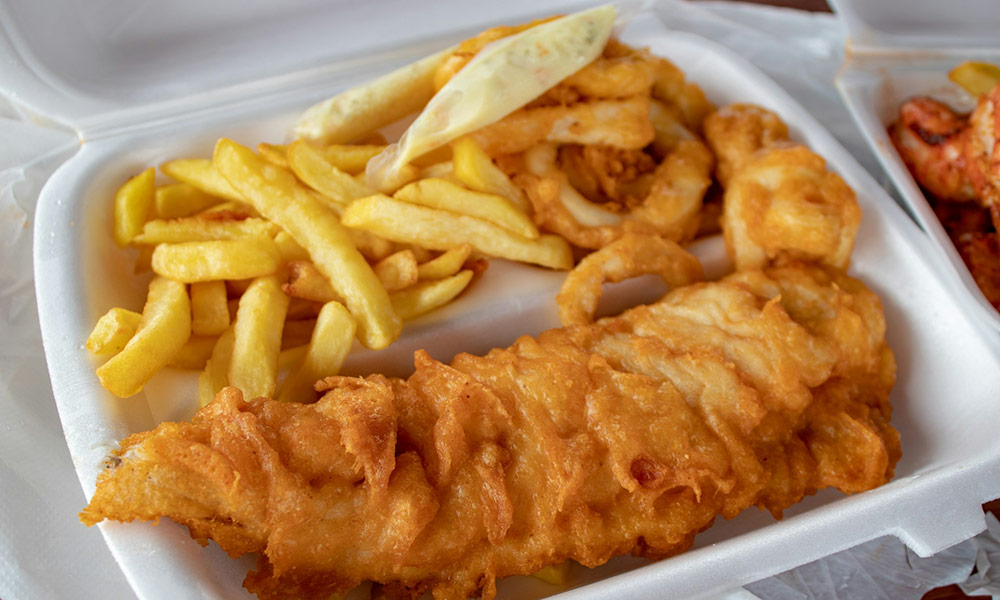
In South Africa, fish and chips usually means hake and chips: a battered fillet of Cape hake with soft, vinegared slap chips. It is a harbour meal at Kalk Bay and Hout Bay that is just as much at home inland, and the fish has a sound sustainability record: the hake trawl fishery has held Marine Stewardship Council (MSC) certification since 2004, and WWF-SASSI keeps trawl-caught Cape hake on its green list.
Two Fish Called Cape Hake
‘Cape hake’ is really two species. Shallow-water hake (Merluccius capensis) lives at depths of 30 to 450 metres along the coast from Angola to KwaZulu-Natal, while deep-water hake (Merluccius paradoxus) is generally found from 200 to 800 metres. Most South African hake fisheries catch the two together, WWF-SASSI notes. Hake can live for about 14 years and reach about 115cm, according to the MSC, which calls trawled hake South Africa’s most important commercial fishery. The fish rise off the seabed at night to feed, so trawlers target them by day.
Kalk Bay and the Harbour Shops
Kalk Bay, on False Bay, is one of the few working fishing harbours in Cape Town. Depending on the time of day, visitors may see fishermen unloading their catch while the resident seals wait for a snack. Cape Town Tourism describes Kalky’s, in the harbour, as arguably the most famous fish-and-chip shop in the Cape Town area, and Time Out says it has served fish and chips since 1996 and always has hake. Time Out also lists harbourside fish and chips at Hout Bay and Simon’s Town.
The habit runs deep. “If you think of fish and chips here, then hake always comes to mind first,” chef Siba Mtongana, an MSC ambassador in South Africa, told the organisation. Nor is it only a seaside meal: writing in Daily Maverick in 2021, Marie-Lais Emond said that when people in Johannesburg ask for fish and chips, they mean hake and chips.
Slap Chips, Salt and Vinegar
The chips matter as much as the fish. South Africans call them slap chips, from the Afrikaans ‘slap’, meaning ‘weak’ or ‘flabby’. The Dictionary of South African English defines ‘slap chips’ as ‘hot fried chips’, often cooked through but not crisp, and the name separates them from ‘chips’ in the sense of crisps. Emond noted that the local chips have moved towards being fried only once, and that even crisp ones get salt and vinegar shaken over them.
A Green-listed Fish
WWF-SASSI puts trawl-caught Cape hake of both species on its green list, because the trawl fishery is certified by the MSC. That certification dates from 16 April 2004, and the MSC says it was the first hake fishery in the world to gain it. The current certificate runs to 2031. SASSI credits the certification process with a dramatic drop in seabird encounters with the fishery, through tori lines hung with coloured streamers that make the trawl cables easier for birds to see, and better disposal of fish waste. The hake longline fishery entered full assessment for MSC certification in July 2026.
The British Cousin, Beside the Pier
Britain’s version has its own origin story. According to Britannica, the fried fish draws on a style introduced by Sephardic Jews. East London and Lancashire both claim to be the dish’s birthplace in the mid-19th century, and research by the National Federation of Fish Friers has pointed to the Malin family in London in the early 1860s. A June 2026 study by Seafish, the UK public body for the seafood industry, estimated that around 7,210 independent fish and chip takeaways are operating across the UK. Haddock dominates in Scotland and parts of Yorkshire and the Midlands, while cod is the most common choice elsewhere. Hake is still what the MSC calls a less popular cousin, though its sales have grown.
On the British coast, the fish supper belongs to the promenade. The National Piers Society says almost a hundred piers stood at the turn of the 20th century and only half remain. Many began as landing stages or promenades and became pleasure piers with pavilions and theatres; between the wars, some were turned into platforms for funfairs and amusement arcades. The writer Daniel Gray, author of Food of the Cods: How Fish and Chips Made Britain, told the MSC that if he could have only one more meal, it would be on a harbour wall.
Fishing is a familiar theme in games for adults, too. Fortune Games has a guide to Fishin’ Frenzy Megaways, a fishing game released by Blueprint Gaming in 2019, explaining how its six changing reels and its fisherman free spins work. It is for adults aged 18 and over only; every result is random, and the odds favour the house, and no charm, ritual or lucky number changes a random result.
At Kalk Bay, the boats still offload onto the quayside, and, as Time Out puts it, there is always hake at the harbour shop.
18+ only. Treat any game as paid entertainment, never a way to make money. Free, confidential help 24/7: National Gambling Helpline, 0808 8020 133.


