
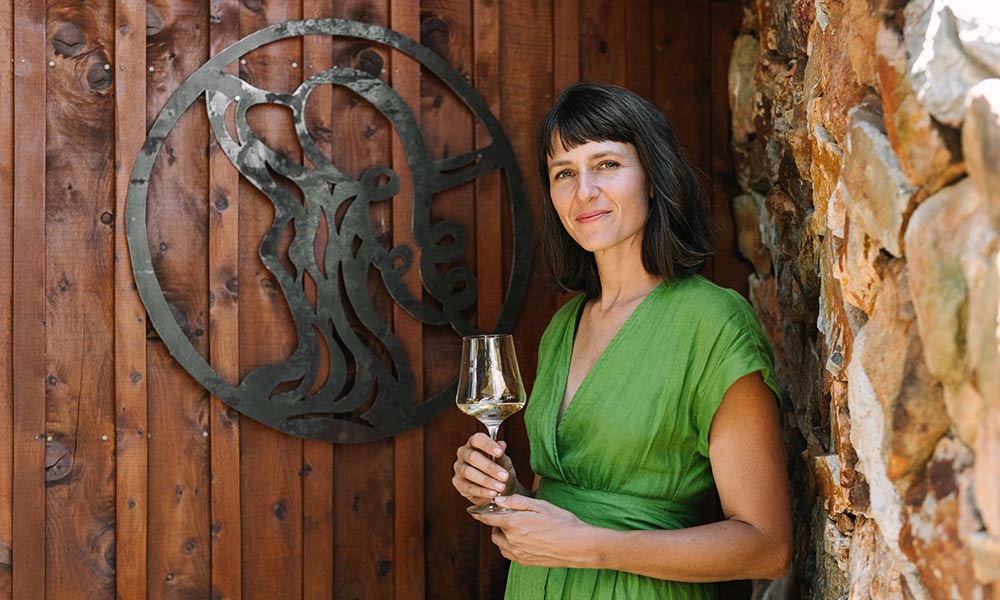
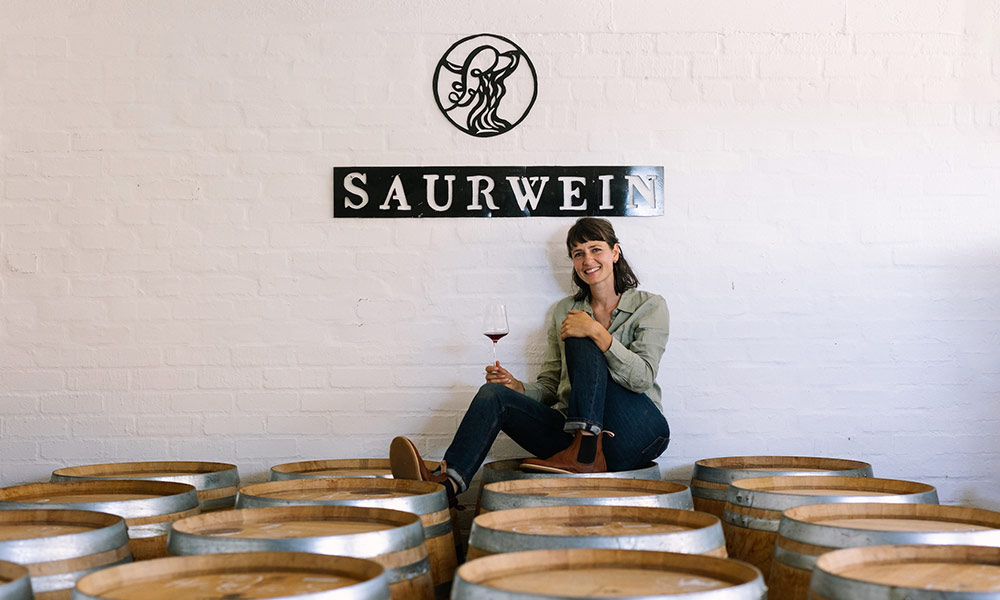
It takes some people years to find their life’s calling, but for others, it’s written in the stars, if not their name. For winemaker Jessica Saurwein, founder of Saurwein Wines, starting her own label was an ode to her maiden name given to her ancestors who made ‘sour’ wine – because it was dry compared to the standard, sweeter wines produced – for the Duke of Austria in the 17th century.
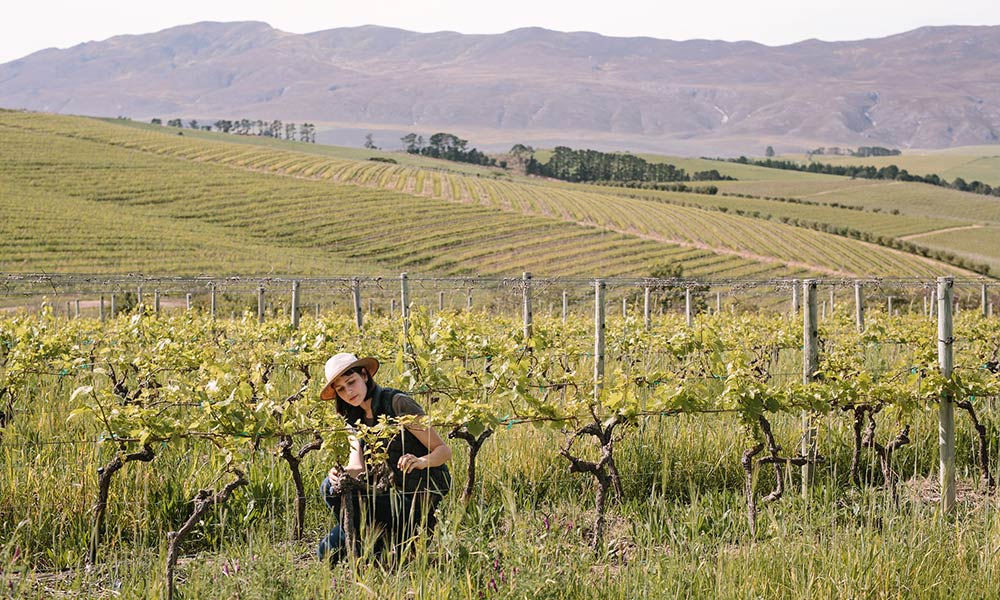
Today, the winemaker and her family run Waterval Farm in the Stanford Valley, where they focus on regenerative agriculture and sustainable winemaking. Sourced from seven local vineyard sites, from Elandskloof to the Hemel-en-Aarde Valley region, her wines carry a distinct flavour profile shaped by her minimal-intervention approach and ‘farming with nature’ philosophy. We chat with Saurwein about her winemaking journey and the inspiration behind her exceptional range. Join the conversation.
Tell us about your winemaking journey.
My love of nature, languages and travel encouraged me to set off on a gap year after school. I first worked on a wine farm in South Africa during harvest season, then travelled Europe. There I secured a stint as harvest assistant in Châteauneuf-du-Pape, one of France’s famous wine regions. After spending my days in picturesque vineyards and working late nights on rickety ladders, I knew that this would be my life’s adventure and completed a degree in winemaking at Stellenbosch University.
Thereafter, I decided that I wanted to work in viticulture, but the only suitable opportunities that arose were in marketing and sales, with yearly harvest exposure. I worked in three different South African winemaking regions, starting with Peter Finlayson, Klein Constantia and then Kleinood in Stellenbosch, where I started making my own wine on the side. I produced my first Pinot Noir in 2015. Then, after my first child was born in 2017, I was committed to being a full-time mom/full-time winemaker for my own brand. In 2021, we bought a farm, and my husband and I started our own vineyard in 2025.
How has your family history contributed to the making of Saurwein Wines?
I don’t come from an immediate winemaking family, but my grandfather was a négociant in Germany, and I enjoyed the mysterious atmosphere in the cellar and the rituals in our family home around the ceremony of opening a bottle of wine. Then, there is my maiden surname, which dates back to 17th-century Austria, with my ancestor having made ‘dry’ wine for the Duke of Austria and being titled according to his trade.
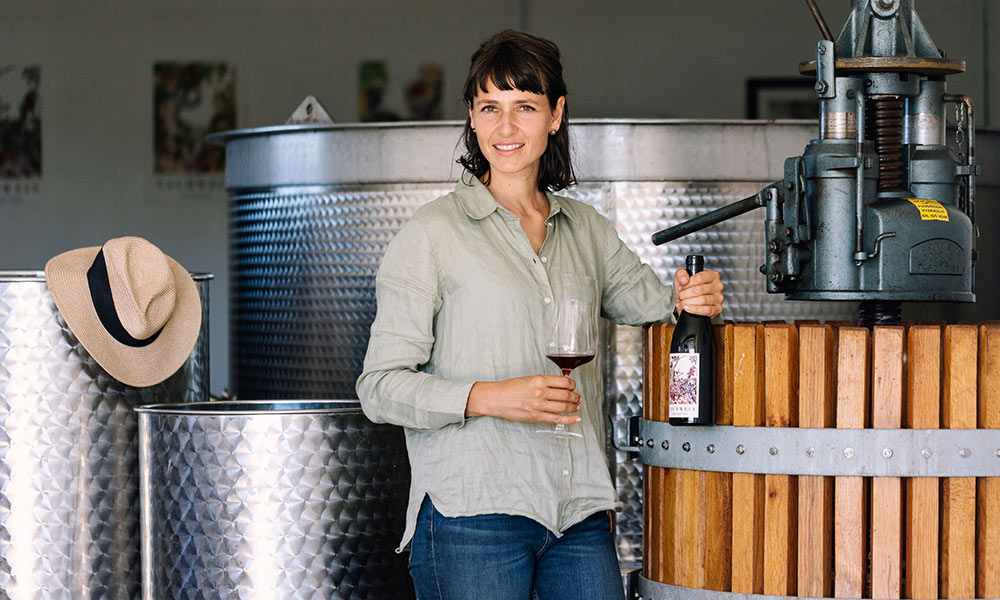
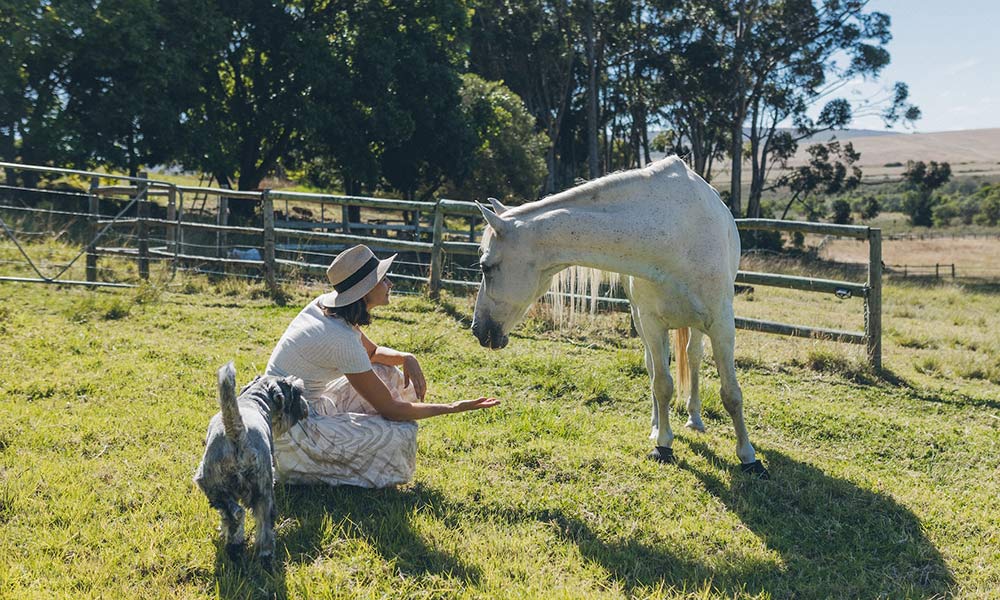
Producing fine wine and developing regenerative agriculture on our own farm has been more than a personal quest. With the help of ‘Nonna’, my mother Charmaine Saurwein, husband Roland Peens, my children, two staff and many animals, minimising inputs and living off the land has become part of the family lifestyle. Roland has been in the fine wine industry for more than two decades, with deep experience in business, marketing and retail, helping us create a powerful force in this traditionally tricky industry.
What inspired the creation of Saurwein Wines?
It was a combination of two things really. Firstly, the need to work for myself, so that I could dedicate as much of myself to my children alongside my dedication to my wonderful work. And secondly, the desire to create delicious wines from unique and special cool-climate vineyard sites along the Cape South Coast.
Did you experience any challenges in starting your own label?
Nothing worth having comes easy, but the many challenges are surmountable when one focuses on gratitude and when one has a passion for wine.
What does ‘farming with nature’ look like?
This is a topic close to my heart. I believe that we live in a world in which it has become far too easy to choose a shortcut. I could go into detail about corporate capture in pharmacological and agricultural systems, but I think that is already understood by many interested in more holistic systems.
‘Farming with nature’ or ‘biological farming’ focuses on the use of non-detrimental aids to mitigate challenges in agricultural systems. It is, in a way, like working with the problems that arise and not against them. When we have weeds, for example, we see these as indicators of the type of soil or the history of farming on a specific site. In other systems, powerful and very harmful herbicides are used to eradicate these plants to diminish competition. These poisons leave long-lasting negative effects on soils, entire ecological systems and on humans. There is evidence that the oceans have even been implicated by toxins used ad lib on large-scale commercial farming ventures that rely on their sales representatives’ seed and products used in conjunction. Regenerative agriculture is a wonderful and simple way to learn how to mitigate the many challenges we face in planting crops. It starts with education/knowledge of the crops, the land and the soils.
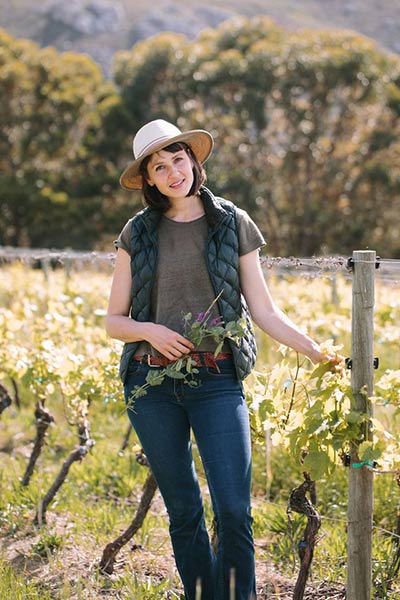
The basic principles can be applied in large and small-scale operations, and even in home gardens. It is possible to eliminate environmentally harmful substances through permanently rooted soils, permanently covered soil, the integration of livestock, minimal soil disturbance and increased biodiversity. On Waterval Farm, we have made our own biochar and wood chips used in compost making and direct mulching from invasive alien vegetation, which we have inoculated with livestock manure; we have a worm farm which produces worm tea for our vineyards, and we have made plant teas, which all help to build soil health and plant immunity. In my view, after seeing the results and witnessing its sustainability, there is no other way.
The range is unique. How was it conceptualised?
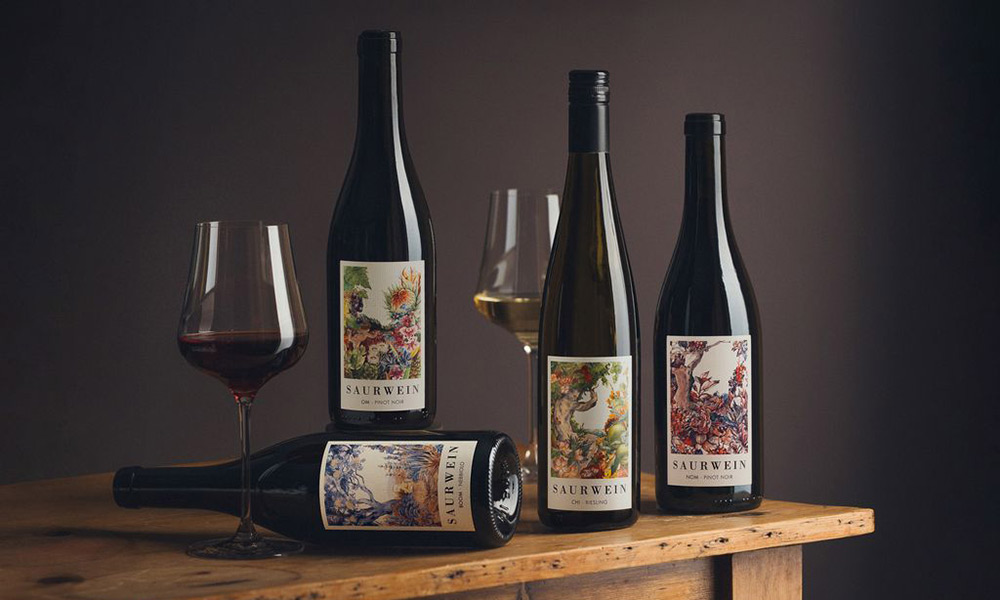
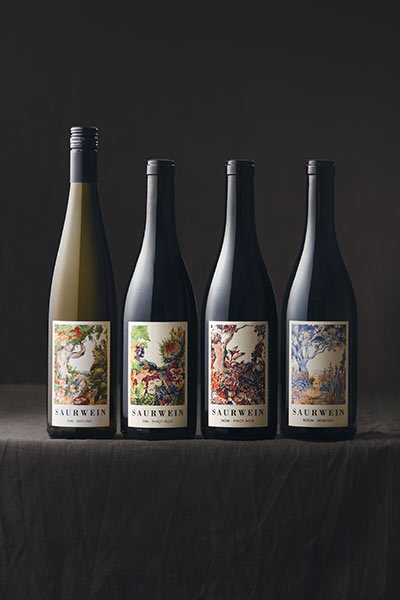
Thank you! I love the labels, and the names have helped translate the visuals. I aimed to paint them myself, but I had to concede that I would not be able to do so. With the help of a friend, I was able to find the best artist for the job. We worked closely together to conceptualise the artwork’s layout, etc.
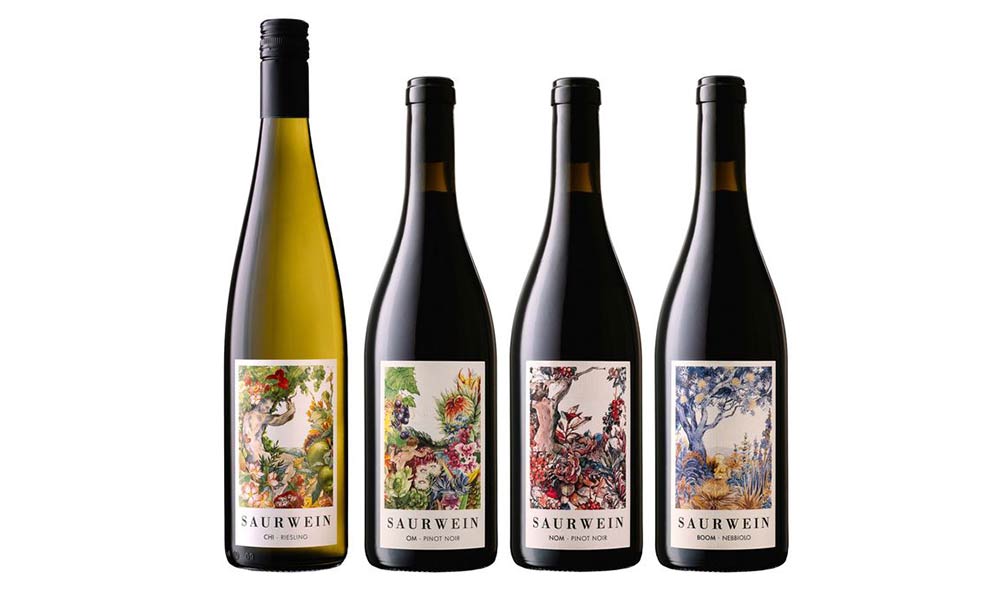
I wanted the label to be a promise of what you find inside the bottle. The Chi Riesling offers fresh, bright imagery and the typical apple and blossoms that are synonymous with the cooler climate regions these grapes are grown in. The Nom Pinot Noir has opulent red and dark berry aromatics, and the colours on the label promise just that. The Om Pinot Noir is a very classic style of Pinot Noir, with fynbos and wild herb notes, red fruit, forest floor, and here too, the label’s multi-coloured flora introduce the wine’s profound content.
The bottle designs are stunning. What was the brief behind the designs?
All the labels are artworks, created in collaboration with fine artist Isabella Kuijers, featuring the South African flora and fauna and alluding to what can be found aromatically in the bottle. We researched the indigenous plants in the nature reserves adjacent to the vineyards, and I gave Isabella the names and the main character or plant that needed to feature, like our national flower, the King Protea and the Waboom in the most recent painting.
Initially, Nom was supposed to be the shapeshifter goddess and Chi, the African rain god, but when my third label was designed, it was obvious to my husband and me that we needed our little firstborn son nestled somewhere in the Hemel-en-Aarde Valley, where we met and fell in love. The Boom Nebbiolo features our second-born son below the ancient Waboom tree on our property, who spent most of his childhood barefoot observing and exploring the outdoors of our farm. I then had designer Robyn de Toorn put the water-colour artworks into the right shape for the bottles and add the brand name, etc.
Take us through the wine names.
The names of the wines are short and are mostly abbreviations for a longer word that relates to the vineyard or the wine itself or both!
Chi Riesling stands for life force, and that is exactly what I feel this off-dry Riesling represents, and it also stands for ‘Chiuta’, the African rain god depicted on the front label.
The Om Pinot Noir stands for universal peace and creation and a feeling imbued when standing in this awe-inspiring vineyard site of the Hemel-en-Aarde Ridge.
Nom Pinot Noir stands for ‘Nomkhubulwane’, an ancient Zulu shapeshifter goddess, who is prayed to for agriculture, beer brewing and fertility. The mystical Kaaimansgat vineyard that is located in the Elandskloof Valley inspired the name of the wine.
Boom stands for ‘Waboom’ (Wagon Tree), which is an indigenous tree, Protea nitida, that is able to withstand fires and can be regarded as an elder. At Saurwein’s home in Stanford, a century-old Waboom grows in a valley just above our vineyards. We take great inspiration from nature.
The best food pairings for each wine?
The nature of the cultivars that I work with makes Saurwein wines versatile.
Asian-inspired dishes, Cape Malay or Indian dishes (with not too much chilli) work very well with both Pinot Noir and Riesling. Nebbiolo can handle richer and fuller-textured dishes with tomato-based sauces/red meats, etc. The best way to find out is to explore.
Do you have a favourite? If so, why?
That’s like asking me if I have a favourite child?! It’s impossible to choose one! It really depends on the mood, the occasion and flavours present when selecting a wine to pair with food.
How do natural fermentation and minimal intervention influence the flavour profiles?
It is my aim to achieve energy and harmony synonymously. The ‘hands-off’ winemaking approach allows me to be guided by the natural balance of the grapes. For this, grape quality is imperative. When you have excellent grapes, you can be a ‘minimalist’ winemaker.
I believe the more you interfere with the inherent balance of wine, the less authentic and the less stable the wine becomes. It is essential that the focus is in the vineyard, and most especially, that we farm the soils before anything else. In the cellar, I follow quite a traditional route, but allow my intuition and the vintage to guide me. The only additive used in the wine is sulfur. This is a natural product of fermentation too, something few consumers know. It is essential in preserving wines and helps us make wines that can age for decades.
What can guests expect on farm open days?
Our nearly monthly open days, hosted by myself and my husband Roland, offer a snapshot into the philosophy behind the Saurwein brand. It is about wholesome and sustainable living, detailed focus and dedication to the highest quality. Working with soil health as the primary goal, we nurture our own vines into life with a focus on working with nature. We showcase our latest releases, along with a few special older releases available from the cellar door and some of our special farm produce like honey, lavender essential oils from a neighbouring farm and my mom’s incredible herb salt, ‘Salt of the Earth’.
Creating a wine label is a major feat. What are you most proud of?
I think I am most proud of my children, who have turned out like my wines: confident, unwaveringly loyal to site and full of personality! I am most grateful for the support of my little village that makes my endeavours as a farmer, winemaker, wife and mother possible. It is a huge privilege to be custodian of a small slice of paradise and to be able to live out a part of our dreams in spite of the constant juggle it is to farm.
How do you see the label evolving?
The label artworks will remain the same, as I love what they represent and how they communicate our story. We will slowly increase the production of our own farmed biological vineyards and continue to strive for excellence in both vineyards and winery.
Any advice for aspiring winemakers?
The sky is the limit. The boundaries that exist are those that we set for ourselves. Marie Curie said it best: ‘Nothing in life is to be feared; it is only to be understood. Now is the time to understand more, so that we may fear less.’ Education is key.
Explore the Saurwein range and purchase wines online.
For more information, visit the links below or click here to send an email.


