
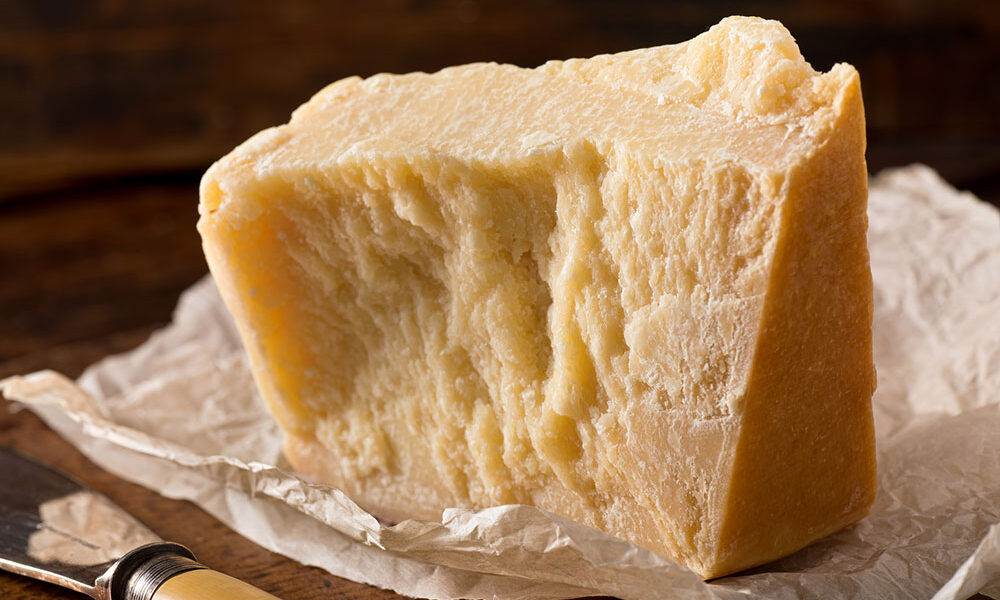
When you’re grating cheese over your pasta or eating shavings straight off the board, you’re probably not asking yourself: Is this Parmigiano Reggiano or Grana Padano? They both taste salty and nutty, and come with impressive Italian pedigrees, but what sets these hard cheeses apart?
You can’t go wrong with either, but they each serve slightly different purposes…
Same country, different regions
Both cheeses fall under the Protected Designation of Origin (or Denominazione d’Origine Protetta in Italian) label, which means they’re legally protected and can only be made in specific regions of Italy using traditional methods. But those regions don’t overlap.
Parmigiano Reggiano can only be made in five provinces in northern Italy – Parma, Reggio Emilia, Modena and parts of Bologna and Mantua. That’s it. No exceptions.
Grana Padano, on the other hand, is made across a much wider area, covering several northern regions like Lombardy, Veneto and Piedmont. So, while both are proudly Italian, Parmigiano Reggiano comes from a much stricter and smaller zone, which already hints at how seriously it takes itself.
It starts with the milk
Here’s where things get a bit more nuanced. Both cheeses are made from cow’s milk, but not all milk is created equally.
Parmigiano Reggiano uses raw, unpasteurised milk from cows that eat a very specific, local diet. Fermented feed, like silage, is not allowed. The milk has to be delivered and processed within a few hours – freshness is everything when producing cheese.
Grana Padano is a little more flexible. It uses semi-skimmed milk, allows silage in the cow’s diet, and also includes lysozyme, a natural enzyme (usually derived from egg whites) that helps prevent unwanted bacteria during the ageing process. This is also what makes Grana Padano unique, as Parmigiano Reggiano doesn’t allow preservatives.
While these production rules may sound like small differences, they play a big role in how the cheese tastes and behaves, resulting in two distinct flavour profiles.
Ageing makes all the difference
Just like wine, cheese gets more complex with age. The older it gets, the more concentrated the flavour – and the more crumbly and grainy the texture becomes.

Parmigiano Reggiano must be aged for at least 12 months, with many wheels going to 24, 36 or even 48 months. The longer it’s matured, the more character the cheese has. This results in a hard, crumbly texture packed with crunchy protein crystals and deep, layered flavour. Expect savoury umami, hints of nuts and fruit, and a little kick of sharpness.
Grana Padano is less high-maintenance when it comes to the production process. It’s aged for a minimum of 9 months, although some wheels go longer. It’s generally softer, creamier and milder, with a smoother, more elastic texture.
How to use make the most of each
Parmigiano Reggiano has a bold, savoury, slightly sharp flavour. It’s salty in the best way, with flavours that linger. It’s dry and crumbly, with a texture that almost sparkles when you bite into it, thanks to the tyrosine crystals. This flavourful cheese is your go-to when you want big flavour. Shave it onto a salad, stir it through a risotto, grate it over pasta or break off chunks to serve with balsamic vinegar and a glass of red. It’s a statement cheese.
Grana Padano is gentler and creamier, with a sweet nuttiness that’s more mellow. Think: less crumbly and smoother, making it great for melting into sauces. Grana Padano is the more everyday option. It’s versatile and melts like a dream. Fold it into sauces or sprinkle over pizza and more.
What about the price tag?
You’ve probably guessed it – Parmigiano Reggiano costs more. Its strict production rules, limited geography and longer ageing contribute to the higher price. But it also packs more punch, so a little goes a long way.
Grana Padano is easier on the wallet and easier to find, especially in local supermarkets. If you’re cooking for a crowd or feeding a hungry household, it makes perfect sense. You can’t go wrong with either, but they each serve slightly different purposes.
Whatever you choose, sprinkle it over these pasta recipes.


